
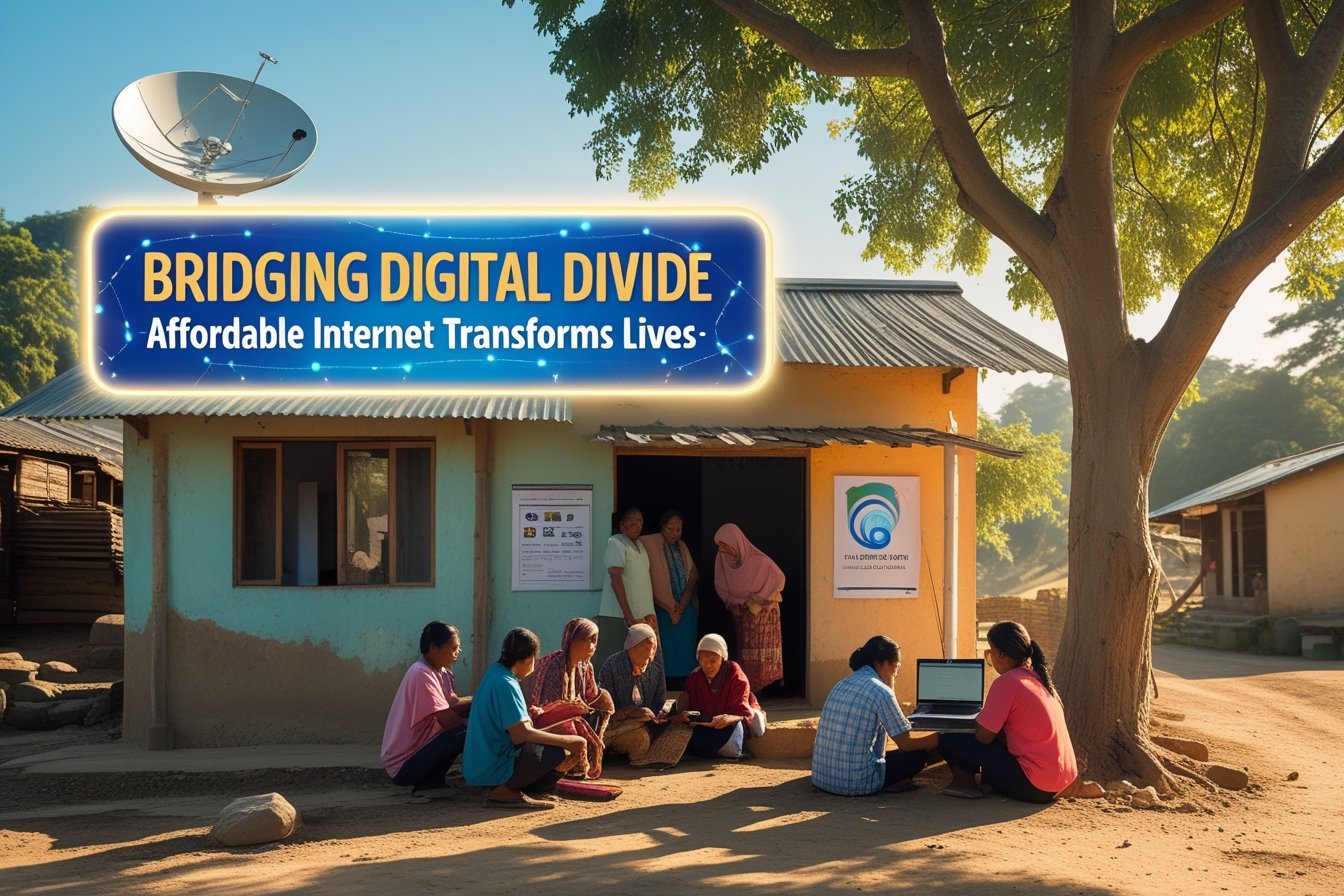

Bridging Digital Divide | Affordable Internet Transforms Lives
A single mother in rural Arkansas loses her job because she cannot attend virtual meetings from home. A brilliant teenager in Detroit watches his college dreams fade as online applications remain out of reach. These aren’t isolated incidents, they’re symptoms of the digital divide that separates connected communities from those left behind. In our hyperconnected world, affordable internet access has become the invisible bridge between opportunity and exclusion, determining who can participate in modern society and who remains stranded on the wrong side of progress.
The Unseen Walls That Keep Communities Apart:
The digital divide creates invisible barriers that are just as real as physical walls. While urban centers enjoy lightning-fast connections and unlimited data plans, entire communities struggle with dial-up speeds, unreliable service, or no internet access whatsoever. This technological segregation affects more than convenience, it shapes fundamental life outcomes.
Rural areas face the greatest challenges, where internet infrastructure remains spotty and expensive to deploy. Telecommunications companies often avoid these regions because low population density makes investment less profitable. The result is a vicious cycle where lack of connectivity prevents economic development, which in turn makes infrastructure investment even less attractive to service providers.
Low-income urban communities experience their own version of digital isolation. Even where high-speed internet exists, monthly costs often exceed what families can afford alongside housing, food, and healthcare expenses. When forced to choose between internet service and basic necessities, connectivity becomes a luxury that many cannot justify, regardless of its long-term importance for education and employment opportunities.
The age factor adds another layer of complexity to the divide. Older adults frequently lack both access to affordable services and the digital literacy skills needed to navigate online environments effectively. This creates a generational gap where seniors miss out on telehealth services, online banking conveniences, and virtual social connections that could significantly improve their quality of life.
Unlocking Human Potential Through Connected Communities:
Affordable internet access serves as a catalyst for transformation across multiple aspects of human development. Education represents perhaps the most dramatic area of impact, where connectivity opens doors to online learning resources, virtual classrooms, and educational opportunities that transcend geographical limitations.
Students with reliable internet access gain advantages that compound over time. They can research assignments using vast online libraries, participate in virtual study groups, access educational videos and interactive content, and submit assignments electronically. During the pandemic, this advantage became starkly apparent as connected students continued learning while others fell behind due to a lack of digital access.
Healthcare delivery has been revolutionized by internet connectivity, particularly through telemedicine services that bring medical expertise to underserved areas. Digital health solutions allow patients to consult specialists without traveling hundreds of miles, monitor chronic conditions through connected devices, and access mental health support that might otherwise be unavailable in their communities.
Economic opportunities multiply exponentially with internet access. Digital employment platforms connect workers with remote job opportunities, freelance projects, and skill development programs that were previously inaccessible. Small businesses can reach global markets through e-commerce platforms, while entrepreneurs can access online tools for accounting, marketing, and customer management that level the playing field with larger competitors.
Social connections strengthen when communities gain internet access. Families separated by distance can maintain relationships through video calls, isolated individuals can find support groups for health conditions or shared interests, and civic engagement increases as people gain access to government services and community forums online.
Revolutionary Approaches to Connectivity Solutions:
Innovative digital divide solutions are emerging that challenge traditional assumptions about internet deployment and pricing. Community-owned networks represent one of the most promising approaches, where local organizations build and maintain internet infrastructure tailored to their specific needs and economic circumstances.
Municipal broadband initiatives allow cities and towns to provide internet service as a public utility, similar to water or electricity. These programs can offer affordable internet plans because they prioritize community benefit over profit maximization. Successful municipal networks demonstrate that high-quality, low-cost internet service is achievable when communities take control of their digital infrastructure.
Mobile-first strategies leverage existing cellular networks to provide internet access more quickly and affordably than traditional broadband deployment. Innovative companies are developing low-cost internet solutions using mobile technology that can reach remote areas without requiring extensive fiber optic cable installation.
Satellite internet technology is experiencing rapid advancement, with new constellations promising global coverage at increasingly affordable prices. While still evolving, these systems could eliminate geographical barriers to internet access and provide backup connectivity options for areas prone to natural disasters or infrastructure failures.
Public-private partnerships combine government resources with private sector expertise to accelerate digital inclusion initiatives. These collaborations can leverage public funding to make private investment in underserved areas more attractive while ensuring that the resulting services meet community needs and affordability requirements.
Measuring the Ripple Effects of Digital Inclusion:
The impact of bridging the digital divide extends far beyond individual users to create positive changes throughout entire communities. Economic development accelerates when areas gain reliable internet access, as businesses can operate more efficiently and attract customers from broader markets.
Educational outcomes improve dramatically in communities that achieve widespread internet access. Students perform better academically, graduation rates increase, and more young people pursue higher education opportunities. Teachers can access professional development resources and innovative teaching tools that enhance classroom experiences and learning outcomes.
Healthcare metrics show measurable improvements in areas with better digital connectivity. Chronic disease management becomes more effective through remote monitoring and virtual consultations, emergency response times improve through better communication systems, and preventive care increases as people gain access to health information and telemedicine services.
Social cohesion strengthens when communities become more digitally connected. Civic participation increases as people can easily access government information and services, community organizations can coordinate more effectively, and residents can stay informed about local issues and opportunities for involvement.
The multiplier effect of digital inclusion creates positive feedback loops where initial investments in connectivity generate additional economic activity, which in turn supports further technology adoption and infrastructure improvement. Communities that successfully bridge the digital divide often become models for neighboring areas seeking similar transformation.
Building Tomorrow’s Connected Society:
The future of digital equity depends on sustained commitment to innovative solutions and inclusive policies. Emerging technologies promise new opportunities for affordable connectivity, but realizing their potential requires coordinated effort from government, industry, and community organizations.
5G networks could revolutionize affordable internet delivery by providing high-speed wireless connectivity that bypasses traditional infrastructure limitations. However, ensuring equitable access to 5G technology requires proactive planning to prevent new forms of digital divide from emerging along economic or geographical lines.
Artificial intelligence and machine learning technologies are creating new possibilities for optimizing network performance and reducing operational costs, potentially making internet service more affordable for underserved communities. These advances could also improve the effectiveness of digital literacy programs by personalizing instruction to individual learning needs and preferences.
Policy frameworks are evolving to recognize internet access as a fundamental utility necessary for full participation in modern society. Government programs are increasingly focused on digital inclusion strategies that address not just infrastructure deployment but also affordability, device access, and digital skills training.
The integration of internet access with other essential services creates opportunities for more efficient and cost-effective delivery of multiple community needs. Smart city initiatives that combine internet infrastructure with transportation, energy, and public safety systems can maximize the return on public investment while improving the quality of life for residents.
Conclusion:
Bridging the digital divide through affordable internet access represents one of the most powerful tools for creating opportunity and reducing inequality in our interconnected world. The transformation extends beyond individual convenience to reshape entire communities, creating ripple effects that touch education, healthcare, economic development, and social connection. Success requires innovative approaches that combine technological advancement with community-centered solutions, ensuring that the benefits of digital connectivity reach everyone, not just those who can afford premium services.
FAQs:
1. What is the digital divide, and who does it affect most?
The digital divide is the gap between people with reliable internet access and those without. It affects rural communities, low-income families, seniors, and minorities most severely.
2. How much does affordable internet typically cost?
Affordable internet plans range from $10 to-30 monthly through government programs and community initiatives, compared to $50-100 for standard commercial service.
3. What are the main barriers to internet access?
High costs, lack of infrastructure in rural areas, limited digital literacy skills, and insufficient device access are the primary digital divide barriers.
4. How does internet access improve educational outcomes?
Students with reliable internet access score higher on tests, have better graduation rates, and gain access to online resources, virtual tutoring, and digital learning tools.
5. What government programs help with internet affordability?
Programs like the Affordable Connectivity Program, Lifeline, and state digital equity initiatives provide subsidized internet service and device assistance to qualifying households.
6. How can communities create their own internet solutions?
Communities can develop municipal broadband, cooperative networks, or partner with nonprofits to build community-owned internet infrastructure that prioritizes affordability over profit.