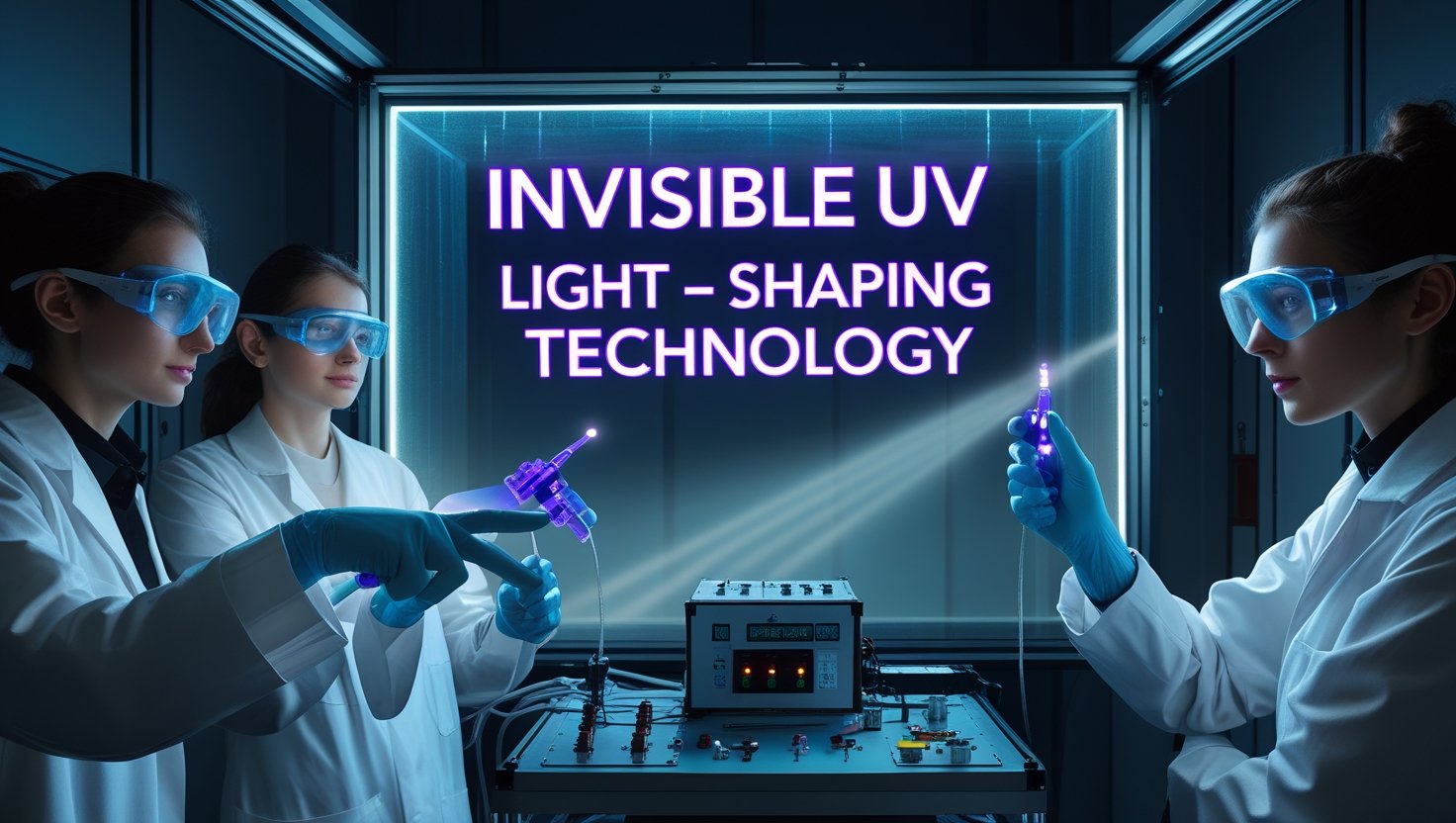
What if the most powerful force shaping tomorrow’s technology was completely invisible to your eyes? Invisible UV light operates beyond human perception, yet it’s quietly orchestrating a technological revolution that touches everything from the smartphone in your pocket to the quantum computers of the future. This unseen electromagnetic spectrum is not just changing how we build technology, it’s redefining what’s possible in our increasingly connected world.
How Invisible Wavelengths Build Tomorrow’s Devices:
Invisible UV light serves as the master craftsman in modern semiconductor manufacturing, wielding wavelengths so precise they can etch patterns smaller than viruses onto silicon wafers. Extreme ultraviolet lithography has become the secret weapon for creating the world’s most advanced microchips, using 13.5-nanometer wavelengths to achieve manufacturing precision that was once considered impossible.
The magic happens in ultra-clean fabrication facilities where UV technology operates with surgical precision, creating transistors that are just a few atoms wide. These invisible light beams don’t just shape silicon – they’re sculpting the future of artificial intelligence, quantum computing, and next-generation electronics. Every smartphone processor, every AI chip, and every advanced computing device owes its existence to this invisible electromagnetic artisan.
Ultraviolet wavelengths enable manufacturers to pack billions of transistors onto chips smaller than a fingernail, pushing the boundaries of Moore’s Law and making possible the computing power that drives our modern digital lifestyle. Without this invisible technology, the AI revolution, high-speed internet, and smart devices that define our era simply wouldn’t exist.
Unveiling Hidden Information Through Light Forensics:
Invisible UV light has transformed into technology’s most sophisticated detective, revealing secrets that remain completely hidden under normal lighting conditions. UV detection systems can uncover everything from security features in currency and documents to biological evidence at crime scenes, creating an entirely new dimension of information that exists parallel to our visible world.
Modern ultraviolet scanning technology goes far beyond simple fluorescence detection, employing advanced spectroscopic analysis to identify materials, authenticate products, and verify document integrity with unprecedented accuracy. This invisible investigation capability has revolutionized industries from banking and pharmaceuticals to art authentication and archaeological research.
The forensic applications of UV light technology continue expanding as researchers develop new fluorescent markers and detection methods. Law enforcement agencies now rely on portable UV devices that can instantly reveal fingerprints, trace evidence, and other crucial clues that would otherwise remain invisible. This technology doesn’t just solve crimes – it prevents fraud, ensures product authenticity, and maintains the integrity of everything from luxury goods to life-saving medications.
Precision Engineering at the Atomic Level:
Invisible UV radiation operates as a molecular surgeon, capable of breaking and forming chemical bonds with extraordinary precision. UV curing technology has revolutionized manufacturing processes across industries, enabling instant polymerization of materials that creates stronger, more durable products in a fraction of traditional processing time.
This photochemical precision extends to UV sterilization systems that can eliminate pathogens without heat or chemicals, making them invaluable for medical device manufacturing, pharmaceutical production, and food safety applications. The ability to precisely control molecular interactions through ultraviolet energy has opened new possibilities in materials science, from self-healing plastics to advanced composites with unprecedented properties.
UV photochemistry is also driving innovations in 3D printing and additive manufacturing, where invisible light wavelengths cure photopolymer resins layer by layer to create complex structures with incredible detail and strength. This technology is enabling rapid prototyping, custom medical implants, and precision manufacturing applications that were unimaginable just a decade ago.
Accelerating Next-Generation Computing:
Invisible UV light plays a crucial role in quantum technology development, serving as both a tool for fabricating quantum devices and a medium for quantum information processing. Ultraviolet photons can excite quantum dots and manipulate quantum states with the precision necessary for building stable quantum computers that could revolutionize computing forever.
The interaction between UV wavelengths and quantum materials creates unique opportunities for developing quantum sensors, quantum communication systems, and quantum memory devices. These applications leverage the high energy of ultraviolet photons to create and control quantum entanglement, the mysterious phenomenon that enables quantum computers to perform calculations exponentially faster than traditional computers.
Research facilities worldwide are exploring how invisible UV technology can improve quantum coherence times and reduce quantum error rates, bringing us closer to practical quantum computers that could solve complex problems in medicine, materials science, and artificial intelligence that are currently beyond our computational reach.
Connecting Living Systems with Technology:
Invisible UV light is creating unprecedented connections between biological systems and digital technology through advanced UV spectroscopy and photobiomodulation techniques. These applications range from non-invasive medical diagnostics that can detect diseases at the cellular level to UV-responsive biosensors that monitor environmental conditions and health parameters in real-time.
Ultraviolet technology enables the development of smart biomaterials that respond to light signals, creating possibilities for drug delivery systems that activate on command, self-monitoring medical implants, and even bio-hybrid devices that combine living cells with electronic components. This convergence of biology and technology opens new frontiers in personalized medicine and biotechnology.
The emerging field of UV optogenetics uses invisible light wavelengths to control cellular behavior and gene expression, potentially leading to revolutionary treatments for neurological disorders, cancer therapy, and regenerative medicine. This technology represents a fundamental shift from passive medical devices to active, light-controlled therapeutic systems that can adapt and respond dynamically to biological needs.
Sustainable Technology Through Invisible Innovation:
Invisible UV light is becoming a cornerstone of sustainable technology development, offering chemical-free solutions for water purification, air cleaning, and surface disinfection that reduce environmental impact while improving effectiveness. UV water treatment systems can eliminate pathogens and contaminants without introducing harmful chemicals into water supplies, supporting global efforts to provide clean water access.
Ultraviolet air purification technology provides continuous, chemical-free pathogen control in buildings, vehicles, and public spaces, contributing to healthier indoor environments while reducing energy consumption compared to traditional HVAC filtration systems. These UV environmental systems are particularly valuable in hospitals, schools, and other facilities where air quality directly impacts human health.
The development of solar-powered UV systems is creating opportunities for off-grid water treatment and air purification applications, bringing advanced sanitation technology to remote communities and disaster-affected areas. This intersection of invisible UV technology and renewable energy represents a powerful approach to addressing global health and environmental challenges sustainably.
Conclusion:
Invisible UV light represents far more than just another technological tool, it’s the foundational force enabling humanity’s greatest technological leaps forward. From crafting impossibly small computer chips to unlocking the mysteries of quantum computing, from protecting public health to advancing sustainable solutions, ultraviolet technology continues pushing the boundaries of what’s possible. As we stand on the brink of new technological revolutions in AI, quantum computing, and biotechnology, invisible UV light remains the silent architect working behind the scenes to build our extraordinary digital future.
FAQs:
Q1: What makes UV light “invisible,” and how does it shape technology?
A: UV light operates below the visible spectrum at wavelengths humans cannot see, yet it enables precise manufacturing of computer chips and advanced materials.
Q2: How does invisible UV light create computer processors?
A: Extreme ultraviolet lithography uses 13.5nm wavelengths to etch microscopic patterns on silicon wafers, creating transistors smaller than viruses.
Q3: Can UV light really detect hidden information?
A: Yes, UV technology reveals fluorescent security features, biological evidence, and authentication markers invisible under normal lighting conditions.
Q4: What role does UV light play in quantum computing?
A: UV photons manipulate quantum states and excite quantum dots with the precision necessary for building stable quantum computers.
Q5: Is UV technology environmentally friendly?
A: UV systems provide chemical-free water purification and air disinfection, offering sustainable alternatives to traditional treatment methods.
Q6: How does UV light connect biology with digital technology?
A: UV spectroscopy enables non-invasive medical diagnostics and controls cellular behavior through optogenetics, bridging biological and digital systems.